
What is project scoping?
Scoping a software project is the stage that comes before development. We set out all your rules and fix the perimeter before any build budget is committed. At Magram, every project starts here, whatever its size.
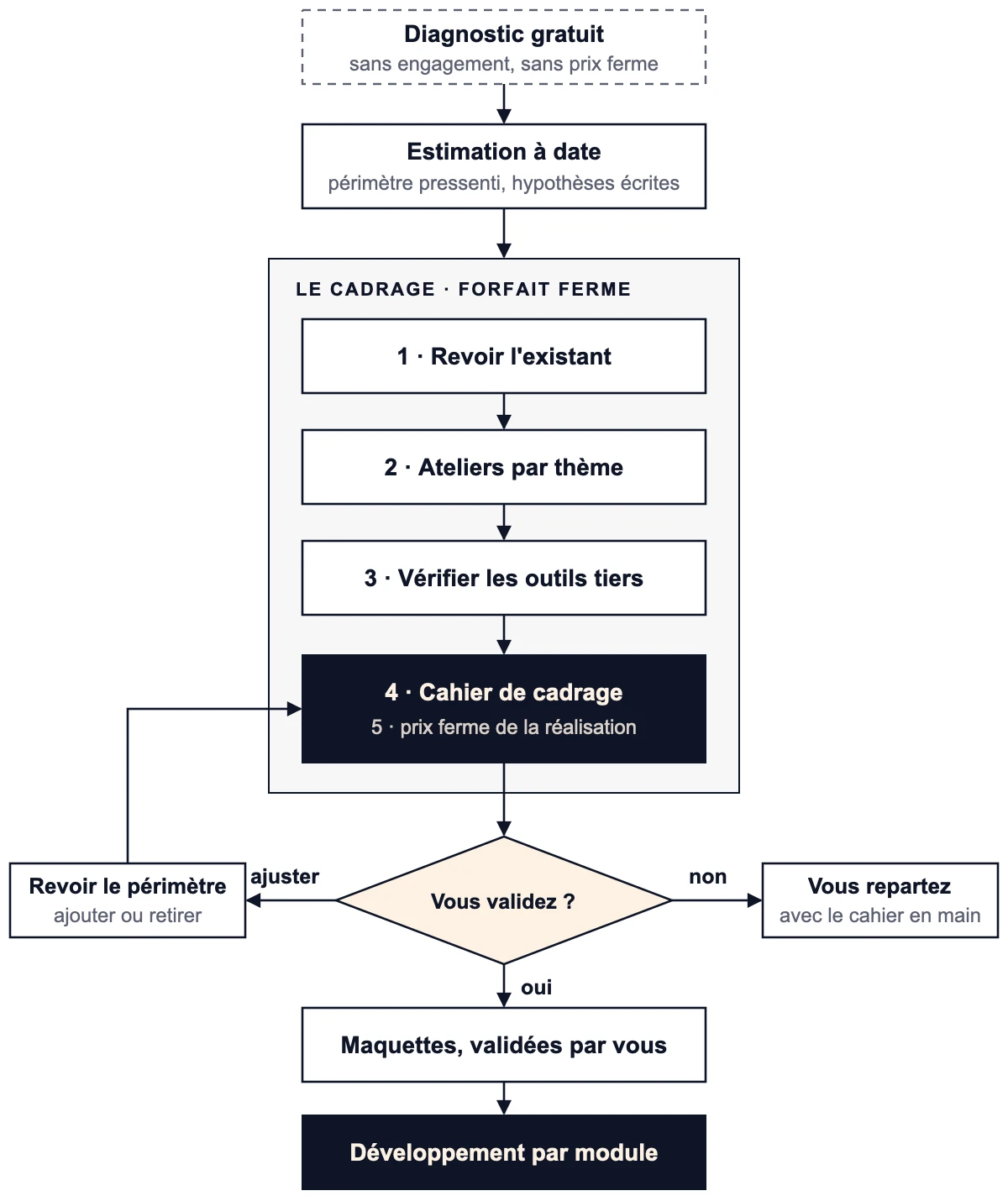
Before scoping, we give you an estimate: the expected perimeter, split into modules and phases, and the assumptions behind the figure. Scoping checks those assumptions one by one and turns the estimate into a fixed price.
Our scoping method at a glance
| Step | What we do | What you bring | What comes out |
|---|---|---|---|
| 1. Review what exists | Reading your current software, your Excel files and your documents | Your real files, templates and documents | The rules nobody ever wrote down |
| 2. Workshops by theme | 3 to 4 workshops, one per major topic | The people who do the work | The detail of each module |
| 3. Third-party tools | Checking the tools to connect, testing on your workstations | Your access and your contacts | What is possible, and at what cost |
| 4. Scoping document | Journeys, rules, roles and permissions, module by module | Review and corrections | The document, the data migration plan, the schedule |
| 5. Fixed price | Costing of the build, assumptions in writing | Your decision | Launch, adjust or stop |
1. Review what exists before talking about the future
We start from what works for you. Before and during the workshops, we read your current software, your Excel files tab by tab, your quotes and your document templates. That is where the rules nobody ever wrote down are hiding, along with the data that will have to be carried over into the new tool.
Example. An industrial SME of about fifteen employees wanted to replace its Excel file for leave, RTT days and variable payroll items. Reading it revealed the real problem: the file relied on two people, and the payroll subtleties ended up in a "comment" column that the accounting firm had to interpret. The priority became: hand the firm frozen data on the 25th of each month, so it no longer has to guess.
2. Workshops by theme, with the people who do the work
We run three to four workshops, each on one major topic: for example quotes, production, invoicing. A workshop lasts up to an hour and a half, sometimes two hours when the topic is complex. Each one brings together the people concerned: management, the assistant, an account manager, someone from the field. On site or by video call.
We go through each module with concrete questions: what information can a partner see? Which can they change? "If someone joins on the 15th of the month, how many meal vouchers do they get?" Some modules go quickly because they are obvious. Others take a whole workshop. This is also where we decide that a module planned in the estimate is not needed after all.
3. Check what depends on others
Business software almost always connects to other tools: your accounting software, your e-invoicing platform, Chorus Pro, an archiving tool, your file server. These connections do not depend on us alone. During scoping we check what each tool really allows: a direct connection, a simple export, or another solution.
When you liked a feature at another vendor, we test it on your workstations before making it a promise. And when a constraint costs more, such as an application that has to work offline on building sites, we cost it separately.
4. The scoping document, module by module
All this work leads to deliverables that belong to you:
- the scoping document: the journey, the rules, the roles and permissions, module by module;
- the data migration plan: what is carried over from your files, and how;
- the schedule and the switchover plan: when the new tool takes over, and when the old one can be switched off;
- the fixed price of the build.
Each rule is written as a scenario you can check yourself. A rule that is still uncertain is marked "to be confirmed" rather than assumed. And what will not be done is written down too.
Example. In the industrial SME's document: an employee joins on the 15th of the month, and their entitlements are calculated pro rata to their presence; a non-manager books an RTT day on a Tuesday, and the request is refused with a clear message, since their RTT days can only be taken on Fridays; a month is closed, and any change is blocked unless an exception is granted, which is logged.
The connection to the ERP, mentioned from the very first conversation, was left out of the first version: the ERP was still being configured, and the immediate need did not depend on it.
5. A fixed price, then your decision
Scoping turns the initial estimate into a fixed price. That price rests on written assumptions: the depth of each module, the tools to connect, the data to carry over. If an assumption changes, the figure moves, and you know why.
You then decide: launch the build, adjust the perimeter by removing or adding a module, or stop there. If you do not continue with us, you leave with a document that any provider can use.
After scoping: mock-ups, then development
Before writing a single line of code, we draw the new journey. The mock-ups are not interactive, but they show where each element sits, screen by screen. You approve them. As on a building site: better to move the window on the plan than after the wall is built.
Development then goes module by module. A phase is delivered roughly every two weeks, tested with your real data: you see the tool progress, and you recognise your own way of working in it.
Scoping meetings: what we expect from you
Your involvement is strong at the start, then it decreases. During scoping, you need to:
- take part in the workshops, with the people who do the work;
- send us your files, your templates and real documents from the first workshop;
- review the document, then approve the mock-ups and each delivery.
We do the reading and writing. During the project, one check-in a week is enough, from 30 minutes to an hour.
What scoping does not guarantee
Scoping reduces uncertainty, it does not remove it. Some information depends on you and can take time. Other rules only show their effects in use: a tool changes as soon as people start using it. That is why, after go-live, we provide up to six months of support in use for the adjustments no scoping could have foreseen.
Frequently asked questions
A few days of work on our side, spread over three to four weeks depending on your availability. The number of days depends on the number of workshops and modules: it is set in the proposal, before you sign.
It is a fixed fee, paid once, set according to the number of workshops and modules. You know its price before committing, and it is the only commitment we ask of you at the start. The quote page gives the order of magnitude.
Because your rules have to be confirmed one by one. A fixed price given before that work would be a price to renegotiate. Scoping removes that uncertainty.
A scoping note is a short project-management document: objectives, perimeter, budget, deadlines, risks. The scoping document goes further: it describes the business rules one by one, module by module, precisely enough to build and test the software.
No, scoping produces it. If you already have one, we start from it and test it against your files and your teams.
The diagnosis is free and without obligation: a conversation to map your tools and find what is holding you back. It tells you whether scoping is worth it, and on what perimeter. It does not inventory your rules and does not give a fixed price.
A question about your situation?
Ask Quentin, he replies personally.