
What is a portal for?
It's a private space, accessible with an account, where everyone sees only what concerns them. A client follows their file there, an employee finds their documents and tasks.
The immediate effect is the same in both cases: repetitive requests disappear from your mailbox, because the answer is available self-service.
Examples
- Real-time tracking of a file or an order
- Document upload and signature
- Member area with rights per profile
- Invoicing and history that can be consulted
- Internal requests and their approvals
What it changes.
You answer the same question ten times a week
“Where is my file?”, “Did you receive my document?”. These exchanges disappear when the information can be consulted, and your availability goes back to the topics that deserve it.
Documents travel as attachments
Versions that cross paths, sends that get lost, and nobody who knows which one is authoritative. In a portal, there is one place and one version.
Everyone must see their share, and nothing else
Rights are defined per profile: a client sees their file, an employee their scope, a manager everything. The barrier is set on the server side, not only in the display.
What it costs, how long it takes.
Every project is unique. These benchmarks come from what we've delivered, and they get sharper at scoping.
The K.O. System, in four steps.
Diagnostic and scoping
We interview the people who will use it, not only those who decide.
Design
Every screen is drawn in your vocabulary, and approved before it is built.
Agentic development
We build fast and cleanly, and you see the tool move forward every week.
Delivery and follow-up
Live with no downtime, with your data. We train your teams, and we stay around.
Who it's for.
File-based businesses
Real estate, consulting, training, healthcare: as soon as a client is waiting for progress on something, the portal replaces back-and-forth with a page to consult.
Organisations with members
Associations, schools, clubs: registrations, schedule, payments and documents in one place, accessible to families or members.
Distributed teams
When employees don't share the same office, the shared space becomes the only place where information can be trusted.
Tools, results.
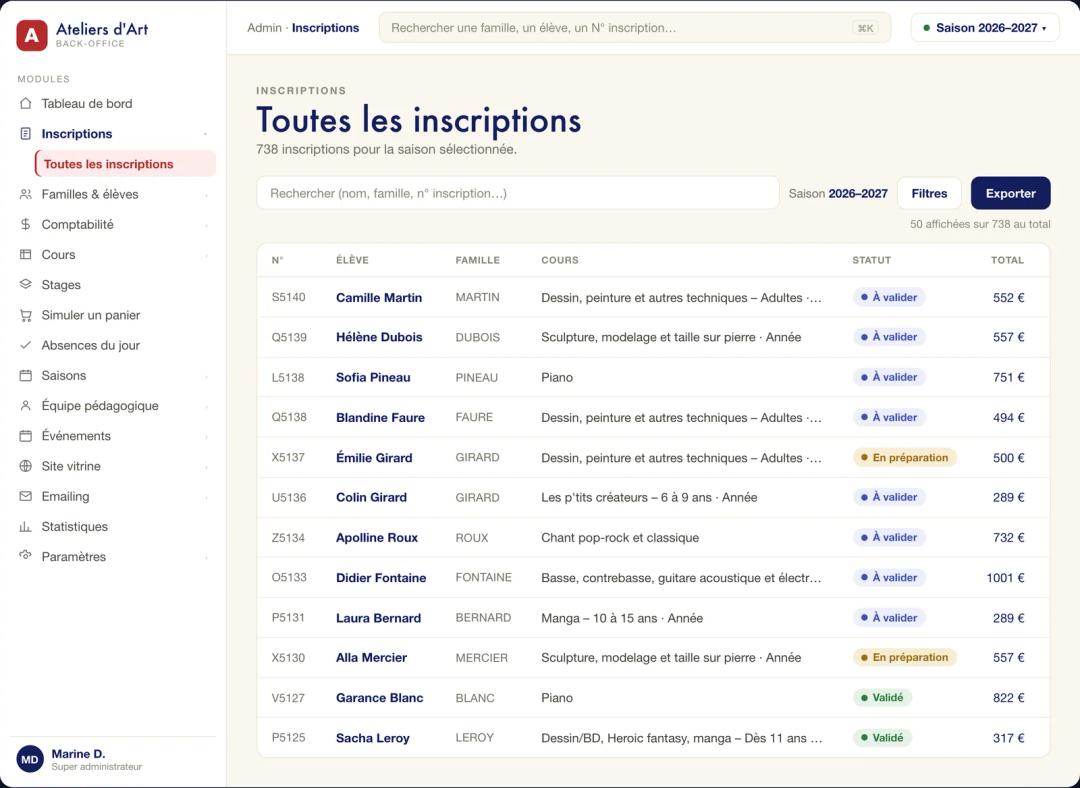
Les Ateliers d'Art
Inscriptions et paiement en ligne, espace familles, gestion des présences : une plateforme sur mesure pour une école d'art qui grandit.

Cavaléa
Refonte complète d'un cabinet d'immobilier équestre : vitrine bilingue, CRM, espace client et alertes automatiques, réunis au même endroit.