What is business software, exactly?
It's a tool built for the precise needs of a company or a sector, where off-the-shelf software imposes its own way of doing things.
It reflects your workflows, your users and your field constraints. It becomes the central place where information lives, instead of being scattered across files, mailboxes and printed sheets.
At Magram, it's co-built with the teams who will use it. That's also the main advantage of custom software: you become autonomous. Your back office and your control room are designed in your image, and everything you want to stay in control of becomes editable by you. You tell us what you want to be able to change, and we make it changeable.
Examples
- Production or site tracking
- Internal request management
- Centralising data scattered across spreadsheets
- Automating tasks that are redone every week
- Project and schedule management
Four situations where custom software makes sense.
Your tools can't keep up with your activity
Spreadsheets multiply, the same information is entered in several places, and discrepancies end up appearing. A single tool centralises the data and removes re-entry.
Your tools don't talk to each other
Accounting on one side, planning on another, customer tracking elsewhere. Reconciliation is done by hand, at the end of the week, by one person. Custom software connects these flows and keeps your indicators up to date continuously.
Your teams don't use the tools in place
A tool that's too complex or too far from the field ends up bypassed, and the data stops being reliable. Designed with the people who use it, in their vocabulary and at the pace of their gestures, it's adopted without having to be imposed.
Your business rules don't fit any box
Approval flows, exceptions, field constraints: every organisation has its own. Off-the-shelf solutions impose their model. Custom software fits yours and evolves with it.
What it costs, how long it takes.
Every project is unique. These benchmarks come from what we've delivered, and they get sharper at scoping.
The K.O. System, in four steps.
Diagnostic and scoping
We interview the people who will use it, not only those who decide.
Design
Every screen is drawn in your vocabulary, and approved before it is built.
Agentic development
We build fast and cleanly, and you see the tool move forward every week.
Delivery and follow-up
Live with no downtime, with your data. We train your teams, and we stay around.
Who it's for.
SMEs with complex processes
Orders, production, planning, approvals: when the chain has several steps and several people, a single tool stops information from getting lost between them.
Multi-site organisations
Several entities or locations to run on the same rules, without constraining what makes each one different. A common base, adapted where needed.
Field trades
When data is entered standing up, on a site or in a workshop, the tool has to be designed mobile first, with as few fields as possible.
Managers who want to move fast
Digitising an internal process or prototyping a tool without waiting six months. We deliver in a few weeks, in iterations.
Tools, results.
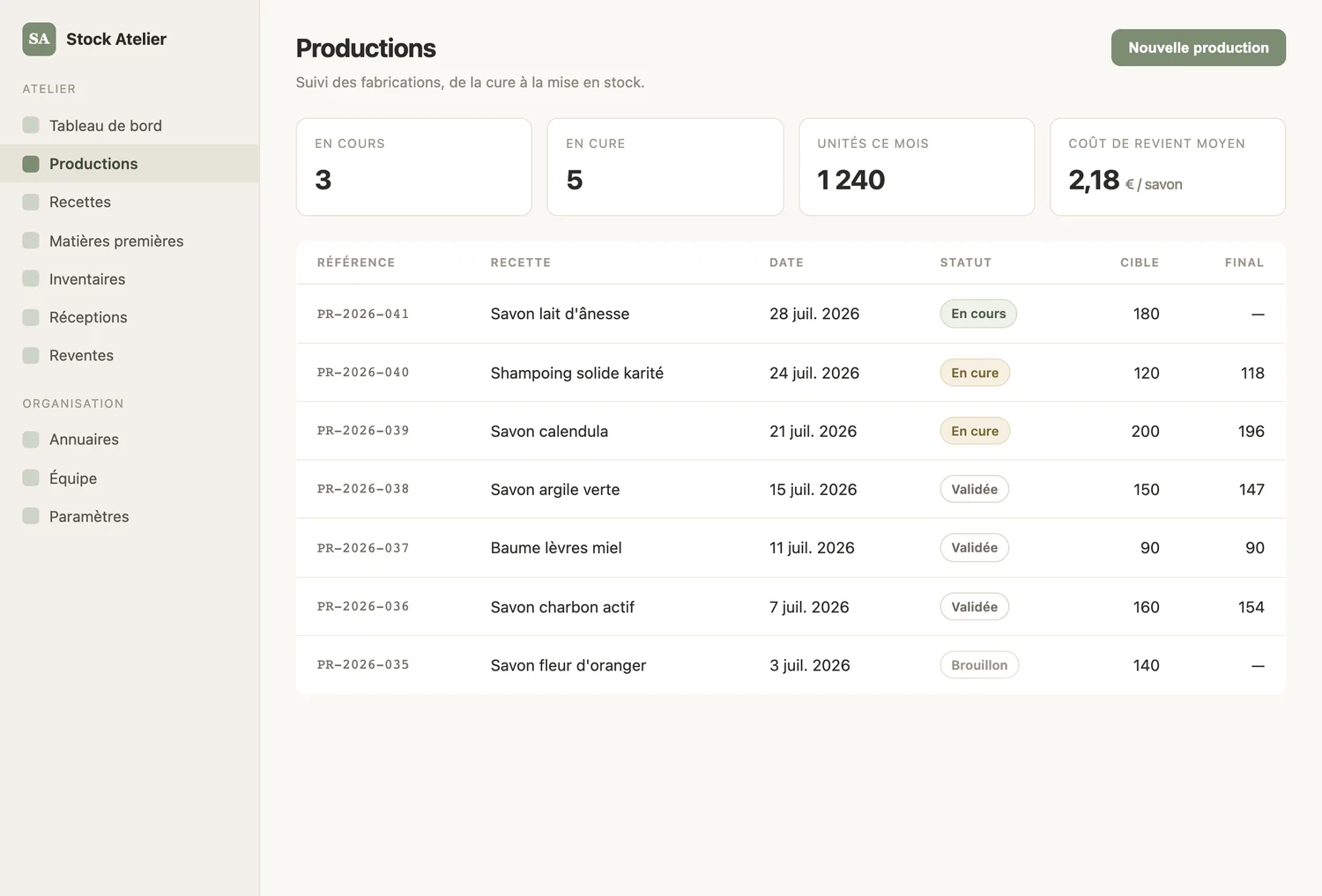
Be by Emma
Un outil métier taillé pour une savonnerie artisanale : recettes, production, matières premières et coûts de revient au même endroit, avec le stock à jour en temps réel.
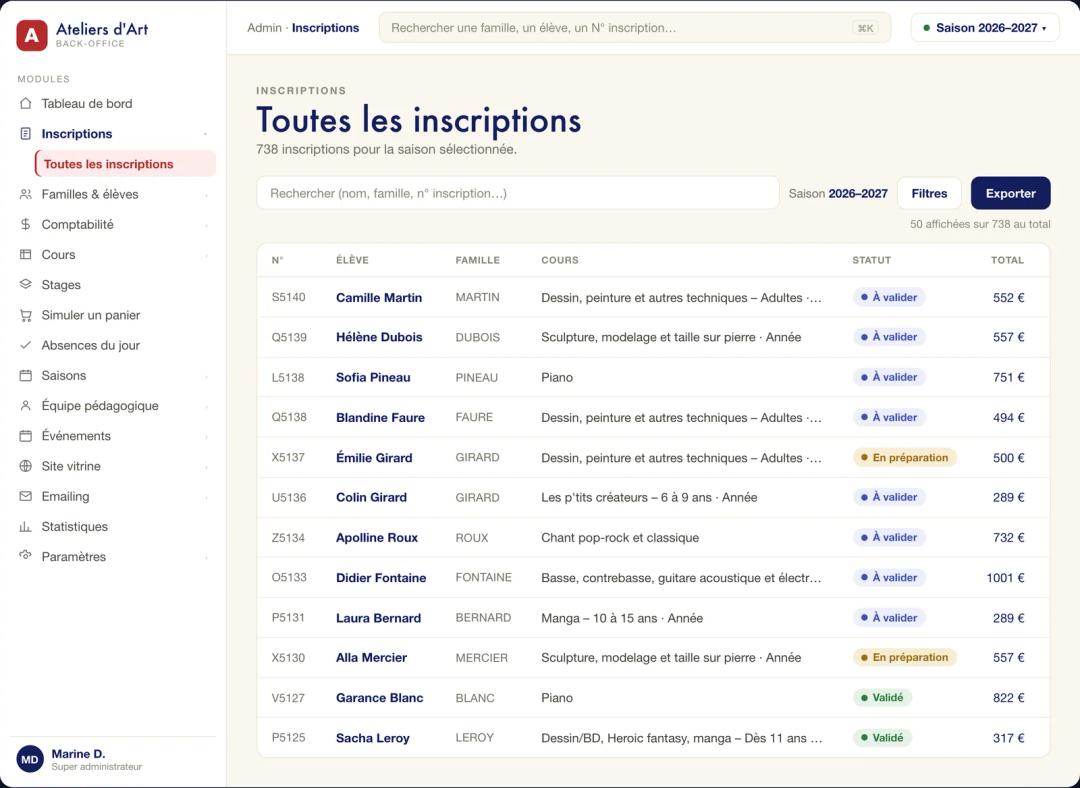
Les Ateliers d'Art
Inscriptions et paiement en ligne, espace familles, gestion des présences : une plateforme sur mesure pour une école d'art qui grandit.
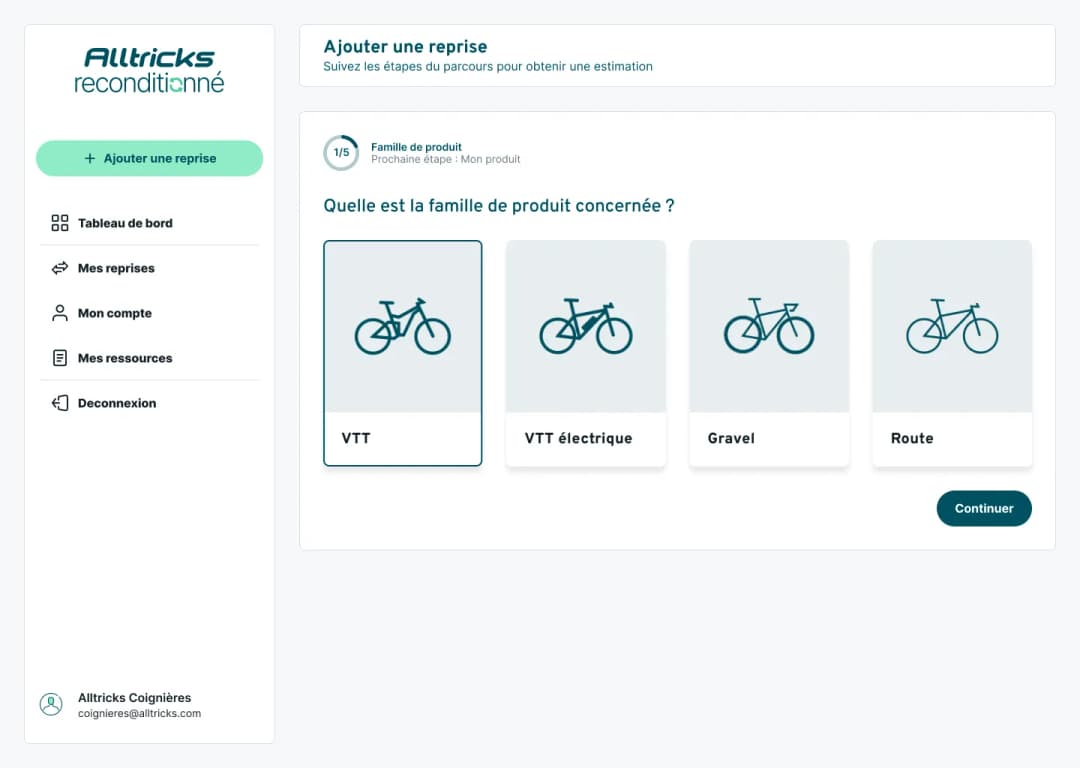
Alltricks Reconditionné
Un outil interne qui relie les magasins et les revendeurs : l'estimation d'un vélo d'occasion au barème officiel, et le suivi de l'acheminement jusqu'à l'entrepôt.